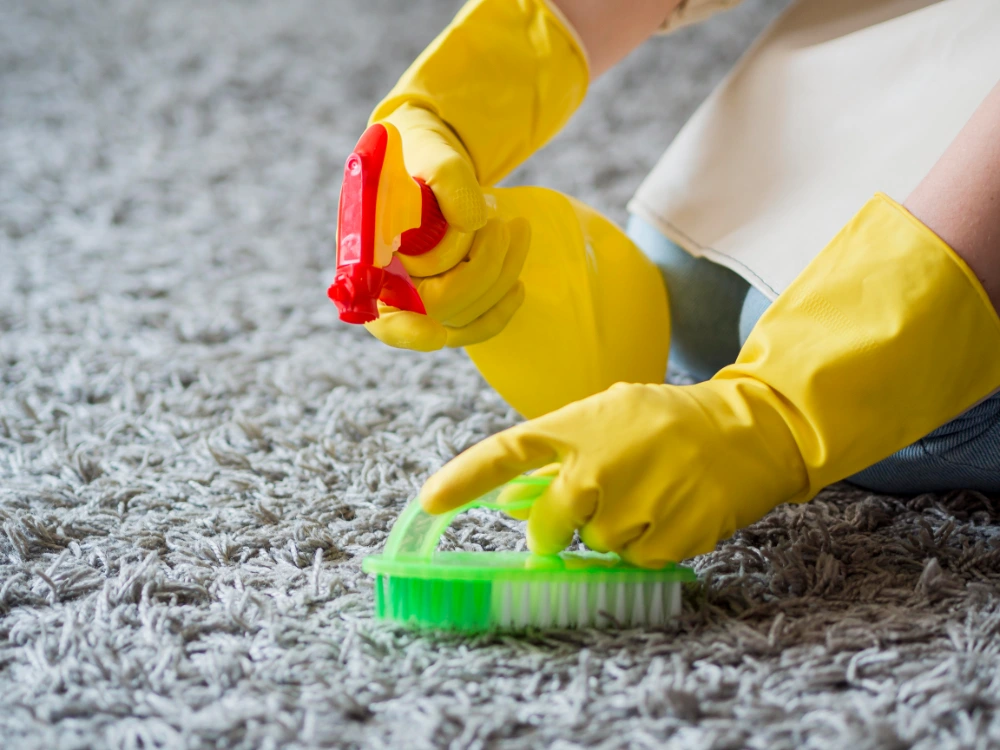
Truck-Mounted HWE
Not a portable machine
Sequestered Rinse Water
Rogue Valley mineral content treated
UV Inspection on Every Pet Job
Not just where you think it is
10-Day Callback Guarantee
Same technician, no forms
WHY IT MATTERS
The Difference Between a Good Clean and a Wasted Afternoon Is Almost Always in the Steps That Happen Before Extraction Starts
There is a version of professional carpet cleaning that goes like this: arrive, spray something, run a machine over the carpet, leave. The carpet looks better for a few days. Then it looks worse than before. The homeowner assumes carpet cleaning just does not work very well, books someone different next time, and the cycle continues.
That version of cleaning is real, and it is what gives the whole industry a mediocre reputation. It skips pre-treatment, under-dwells the chemistry, over-wets the carpet, and leaves without checking whether the extraction actually worked. It is also faster, which is why it happens.
What we do is different — not in a marketing sense, but in a mechanical sense. The steps are different, the sequence matters, and the details of each step have a direct and measurable effect on the result. We are going to walk through all of them.
One thing upfront: there is no carpet cleaning method that fixes everything. Permanent stains are permanent. Pile that has been physically damaged cannot be restored by cleaning. Where those limitations apply, we say so before we start — not after we have taken your money.
WHAT THIS PAGE COVERS
Eight Incredible Steps, Explained in Full
We do all eight on every job. Some companies do three or four. That gap explains most of the variation in results.
STEP 01
The Walkthrough — Before a Single Piece of Equipment Comes Off the Truck
The walkthrough is not a formality. It is the most important ten minutes of the job. We walk every carpeted room with you before we start. We are looking at four things: the carpet type and fibre, the specific soiling or problem areas, anything that might affect the method we use, and the final price. That last point matters because the price we confirm at the walkthrough is the price on the invoice. Nothing is added after we start.
🧶
Fibre Type
Nylon, polyester, triexta, olefin, and wool all respond differently to chemistry and temperature. Wool requires lower pH and heat. Olefin is heat-sensitive. Nylon and polyester are the most common in Medford homes. If we are not sure of the fibre, we do a burn test or check the backing label.
🔍
Soiling Pattern
Surface soiling, traffic-lane soiling, and embedded soiling all require different pre-treatment. Traffic lanes have compressed, oxidised soil that needs alkaline pre-spray with extended dwell. We identify permanent staining before we start — not after.
🔦
Problem Areas
Pet urine (UV inspection at this stage), wildfire smoke contamination, mould, moisture damage, or subfloor issues. We identify them upfront, explain what we will do, and give you an honest assessment of expected outcomes.
🪑
Furniture
We move standard furniture as part of the job. We do not move electronics, large pieces, or items with fragile legs. We place furniture tabs under legs before we leave so furniture can return to damp carpet safely.
STEP 02
Pre-Vacuuming — The Step That Most People Do Not Realise Matters This Much
Dry soil — grit, dust, pet hair, organic debris — does not dissolve in water. Running hot water through a carpet that has not been pre-vacuumed turns dry soil into wet soil, which then moves around the carpet during extraction rather than being removed.
Pre-vacuuming removes the loose particulate before water is introduced. It makes the chemistry more effective because it is working on embedded soiling rather than being diluted by surface debris. It also extends the interval before the carpet re-soils after cleaning — because dry soil left in the pile continues to act as an abrasive.
We use a commercial-grade HEPA vacuum, not a domestic vacuum. Domestic vacuums recirculate fine particles through their exhaust. A HEPA-filter vacuum traps them. In Medford homes, this is particularly important during and after wildfire season — PM2.5 particulate that has settled into carpet pile mixes with moisture during extraction and can spread through the carpet if it has not been loosened and removed first.
STEP 03
Fibre Assessment — Because the Chemistry Has to Match the Carpet
Different carpet fibres require different cleaning chemistry. Getting this wrong causes shrinkage, colour bleed, fibre distortion, or accelerated re-soiling. We assess the fibre and set the chemistry before applying anything.
Nylon
The most durable synthetic fibre. Wide pH tolerance — handles alkaline pre-sprays and acid rinses. The most common fibre in Central Point and Medford family homes. Responds well to hot water extraction at standard temperatures.
Polyester / Triexta
Good stain resistance due to low absorbency, but prone to oily soil bonding to the fibre surface. Requires lower extraction temperature than nylon to avoid crushing the pile permanently. Common in newer Rogue Valley construction.
Olefin (Polypropylene)
Attracts oily soil more than any other fibre. Low melting point — over-agitation or high water temperature causes permanent pile distortion. Used frequently in loop-pile Berber. Requires solvent-based spotter for oily stains.
Wool
Natural protein fibre. pH-sensitive — alkaline chemistry above pH 10 causes felt damage and dye bleeding. Requires wool-safe chemistry (pH 5–8), lower water temperature, and extended drying with airflow underneath. Common in older Ashland homes.
COLOURFASTNESS TEST
On any carpet with dye instability concerns — older carpet, heavily dyed fibres, or unknown origin — we do a colourfastness test in a hidden area before applying any chemistry. A wet white cloth is pressed and rubbed on the fibre. Dye transfer indicates the carpet will not tolerate standard aqueous cleaning.
STEP 04
Pre-Treatment — Where Most of the Real Cleaning Happens
This is the step that most people do not know exists — and the step that most explains why some professional cleans work and others do not.
Carpet cleaning chemistry works on a principle called emulsification: the cleaning agent breaks the bond between soil particles and carpet fibres, suspending them in solution so extraction can remove them. But emulsification requires dwell time to work. You cannot spray and immediately extract and expect a real result. The chemistry has not done its job yet.
TRAFFIC-LANE PRE-CONDITIONER
Applied to high-use areas — hallways, living room paths, the strip in front of the sofa. Traffic lane soil is characterised by compacted, oxidised particulate pushed into the pile base over time. Typically alkaline (pH 9–11), designed to loosen the bond between this type of soil and the fibre. Needs at least 5–10 minutes of dwell to work.
ENZYME PRE-SPRAY FOR PET URINE
Enzyme cleaners work by biological action — the enzymes break down the uric acid crystals in pet urine, eliminating the odour source rather than masking it. Require 10–15 minutes dwell minimum, 20 minutes for heavy contamination. Applied to all UV-confirmed zones plus a 3-foot buffer — because urine migration through carpet and pad means the contamination zone is always larger than the visible stain. Products labelled “odour eliminator” that do not enzymatically break down uric acid only mask the smell. When the carpet gets wet again, the smell returns — because the uric acid crystals are still there.
SMOKE PRE-SPRAY — ALKALINE PROTOCOL
Wildfire smoke contamination requires a dedicated alkaline pre-spray (pH 10–11) to break the chemical bond between PM2.5 particles and carpet fibres. PM2.5 from Jackson County wildfire events bonds to fibres through electrostatic attraction and the oils present in the fibre structure. Standard cleaning chemistry is not alkaline enough to loosen this bond. Applied to all affected areas with a minimum 12–15 minute dwell. This is why carpets can smell clean immediately after a standard clean and then smell smoky again within days — the surface was cleaned; the bonded PM2.5 was not removed.
SPOT PRE-TREATMENT BY STAIN TYPE
Tannin stains (coffee, tea, red wine): acid-based spotter. Protein stains (blood, egg, dairy): enzyme-based spotter, cold water only — heat sets protein stains permanently. Oil and grease: solvent-based spotter. Ink: specific ink remover. We do not guarantee stain removal, particularly for stains treated with shop-bought products containing bleach or optical brighteners that cause permanent colour change. We assess each stain at the walkthrough.
STEP 05
Dwell Time — The Waiting That Determines Whether the Chemistry Works
Dwell time is the period between applying pre-treatment and beginning extraction. It is the most commonly skipped or shortened step in professional carpet cleaning, and shortening it has a direct negative effect on the result.
The chemistry in pre-treatment products requires time to penetrate the pile, reach the soil bond, and break it. Applying pre-treatment and immediately extracting is functionally similar to rinsing a pan before the washing-up liquid has had time to work on the grease.
What we do during dwell time: agitation. Most pre-treatment products benefit from light mechanical agitation — a grooming brush run through the pile to help the chemistry reach the base of the fibres. On traffic-lane soiling, agitation during dwell time significantly improves extraction results. We are also setting up the truck-mount, checking extraction settings, and preparing spotters for the post-extraction pass.
STEP 06
Hot Water Extraction — What It Actually Is and Why Equipment Choice Matters
Hot water extraction (HWE) is the cleaning method recommended by most major carpet manufacturers and the IICRC for deep cleaning synthetic and wool carpet. It is often called “steam cleaning” — which is technically inaccurate, as the water is hot but not converted to steam at the point of application.
TRUCK-MOUNT
What We Use
Water temp
200–240°F at machine · 160–190°F at wand
Vacuum power
12–16 inches mercury vacuum
Waste
Contained in truck tank
PORTABLE MACHINE
What Most Others Use
Water temp
120–150°F maximum
Vacuum power
4–8 inches mercury vacuum
Waste
Drains to your sink / limited tank
ROGUE VALLEY MINERAL CONTENT — WHY WE USE SEQUESTERED RINSE WATER
Our rinse water is treated with a sequestering agent before it enters the extraction system — specifically addressing the calcium and magnesium content in Medford and Central Point’s water supply. Without it, those minerals deposit on carpet fibres as the water evaporates. The carpet looks clean for a few weeks, then turns grey. That is mineral redeposition, not re-soiling. It is the single most common reason homeowners in the Rogue Valley feel like professional carpet cleaning “does not last.”
STEP 07
The Rinse Pass — Why We Do One and What Is In the Water
After the main extraction pass, we run a rinse pass on all cleaned areas. Two purposes: it removes residual cleaning chemistry from the pile — pre-treatment products left in the carpet attract soil, so a properly rinsed carpet re-soils more slowly. And it deposits our sequestering agent throughout the pile, binding remaining mineral ions before they can form the grey mineral film that causes rapid re-soiling in hard-water areas.
The rinse solution is pH-balanced to be slightly acidic (pH 6–7) — this neutralises any residual alkalinity from the pre-treatment and leaves the fibre in a neutral pH state that reduces static and improves soil resistance. A properly rinsed carpet dries cleaner, re-soils more slowly, and maintains its appearance longer. The rinse adds time to the job. It is not optional.
STEP 08
Drying and the Final Walkthrough — We Do Not Consider the Job Done Until the Carpet Is Dry
3–5 hours
Summer (Jun–Sep)
Synthetic carpet
5–8 hours
Spring / Autumn
Synthetic carpet
6–10 hours
Winter (Nov–Feb)
Higher humidity
6–12 hours
Wool (any season)
Airflow both sides
We check carpet moisture with a moisture meter before we leave — pile and backing. A dry pile over a wet backing will develop mould smell within days. We bring industrial air movers (fans) to every job and set them up where needed. We place plastic furniture protector tabs under all furniture legs to prevent rust transfer and dye bleed onto damp carpet.
POST-CLEAN WALKTHROUGH
We walk through every room with you before we leave — pointing out what responded well, any stains we could not fully remove and why, any issues we identified during the job, drying time estimate, and fan placement. The 10-Day Guarantee: if anything wicks back or does not hold within 10 days, call us. Same technician returns. No forms, no argument, no charge.
ROGUE VALLEY FACTORS
How Local Conditions in Medford & Jackson County Affect Every Step
🔥 Wildfire Smoke (June–September)
During the worst events, PM2.5 particles settle into every horizontal surface. Carpet, being the largest horizontal soft surface in most houses, absorbs a significant volume. Our smoke pre-spray protocol was developed specifically for Rogue Valley conditions, adapted from smoke remediation chemistry. A standard clean with deodoriser added is not equivalent.
💧 Hard Water Mineral Content
The Medford and Central Point municipal water supplies carry measurable calcium and magnesium content. Homeowners who have used operators without sequestering agents have usually experienced carpets that grayed back within weeks. That is not re-soiling. That is a chemistry problem with a chemistry solution — and we cover it on every job.
🌾 Pollen Season (February–May)
The Rogue Valley’s pear orchard legacy and Siskiyou / Cascade convergence means spring pollen loads here are among the highest in Oregon. HEPA pre-vacuuming is particularly important on spring jobs because it removes the dry pollen layer before water is introduced — preventing it being pushed further into the pile during extraction.
HONEST LIMITATIONS
What Professional Carpet Cleaning Cannot Fix — And What We Will Tell You Before We Start
Permanent Stains
A stain that has oxidised into the fibre — bleach spots, old red wine, permanent marker, strong dyes — has chemically altered the fibre itself. Cleaning removes soil. It cannot reverse chemical alteration. We identify permanent stains at the walkthrough and tell you honestly what to expect.
Carpet That Needs Replacement
A carpet with physically damaged pile — crushed, cut, torn, or worn through to the backing — cannot be restored by cleaning. We tell you if a carpet is past the point where cleaning delivers real value. We would rather lose a job than take money for something that will not produce a meaningful result.
Subfloor Contamination
Severe pet urine contamination that has penetrated through the carpet and pad to the subfloor cannot be fully resolved by cleaning the carpet face alone. In those cases, we discuss pad removal and subfloor treatment as a separate option. We do not clean carpets with active mould — mould remediation is a separate discipline.
PROCESS QUESTIONS ANSWERED
What People Ask Us About the Process Before They Book
A two-bedroom home with average soiling typically takes 1.5 to 2.5 hours from arrival to completion, including the walkthrough and drying setup. A heavily soiled three-bedroom rental with pet treatment might take 3.5 to 4.5 hours. We give you an honest time estimate at the walkthrough.
Yes, if you can — it helps. But we pre-vacuum as part of our process regardless, with a commercial HEPA machine. Your domestic vacuum beforehand removes surface debris and makes our pre-vacuum faster. If you do not have time, do not worry about it.
You can walk on the carpet in clean socks or bare feet as soon as we leave. Avoid shoes — especially dark-soled shoes — until the carpet is fully dry, as they can transfer soil and dye. Keep pets off until dry where possible.
This is called wicking. Soil from deep in the pile or the backing migrates upward through the fibres as moisture moves through the carpet during drying. It is most common on very soiled carpets or carpets with contamination in the backing. It usually settles as the carpet fully dries. If it does not, call us within 10 days — that is exactly what the guarantee is for.
The IICRC recommends every 12 to 18 months for a typical household under normal use. In Medford and Jackson County, where wildfire smoke season runs June through September and pollen loads are significant in spring, annual cleaning is sensible for most households. More frequently for homes with pets, allergy sufferers, or high foot traffic.
Yes. Our truck-mount system heats water independently of ambient temperature. The main impact of cold weather is drying time — expect 8–12 hours in Medford winter conditions rather than 4–6 hours in summer. We account for this in our fan placement and drying setup.
“Steam cleaning” is the common name for hot water extraction. The water delivered by professional HWE equipment is hot (160–190°F at the wand) but not converted to steam. True steam cleaning uses vapour at 212°F+ and is used for hard surfaces, not carpet. When a company advertises “steam cleaning,” they almost certainly mean hot water extraction.
Call us within 10 days. Stain reappearance after cleaning is usually wicking — the stain source is in the backing and has migrated back up through the pile during drying. We return at no charge and address the source. This does not apply to permanent stains we identified and documented at the walkthrough.
Questions About Our Process or Ready to Book?
Call us directly and ask anything you want to know before you commit to a booking. We would rather spend five minutes on the phone answering questions than have you book a clean without understanding what to expect. If you are in Medford, Central Point, Ashland, Eagle Point, or anywhere across Jackson County, call (541) 622-0999.
FIND US IN MEDFORD, OREGON
Carpet Cleaners Medford
📍 925 N Central Ave
Medford, OR 97501
🕐 Mon–Fri 8am–6pm
Saturday 9am–5pm
🌎 Serving Medford · Central Point · Ashland · Eagle Point · White City · Talent · Jackson County
© 2026 Carpet Cleaners Medford. All rights reserved.